





Eye For Film >> Movies >> Mr. Nobody Against Putin (2025) Film Review


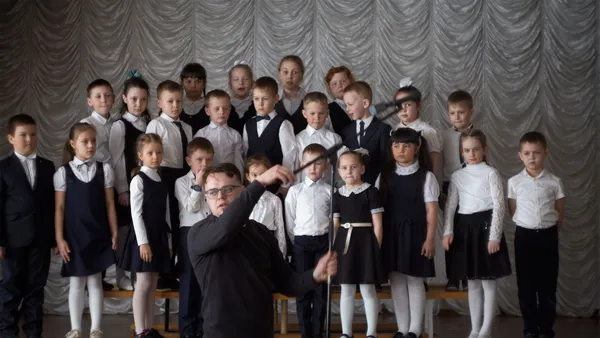

What do you do when you see fascism beginning to exert a grip on day to day life in your country? Many people try to keep their heads down and hope that it will blow over, or outright deny that it’s happening, or even try to curry favour with the new elite. A few people risk everything to stand up and speak out. It’s complicated for a teacher who has the well-being of his students to think about. Pasha Talankin wanted to protect their future, to make sure that what they were taught was true, but he had to think about their safety as well as his own. Then he unexpectedly made contact with US filmmaker David Borenstein, and a new possibility presented itself.
Talankin worked as event coordinator and videographer at Karabash Primary School #1. Karabash, at he explains at the start of this covertly captured documentary, is a small town in the Urals famous for its copper smelting plant and for having the worst pollution in the world, with an adjacent mountain stained black by waste, and a life expectancy of 38. Nevertheless, old footage of the school shows a bright, clean, happy place, where Pasha made sure that there was cake for everybody on special occasions. We see clips of him at work and it’s clear that he was popular with the kids. Outside school, his emotional life centred around his mum, the local librarian. He claims that he never told her he loves her, but he gave her bouquets of flowers all the time.

Everything changed in February 2022, when a new ‘patriotic education programme’ was imposed from above. A whole new curriculum was imposed, with an evidently narrower scope. Between Talankin’s complaints and those of some of the other teachers, it becomes clear that parts of it are wholly fictitious, others heavily exaggerated in their presentation of historic Russian achievements. We see teachers hesitate when obliged to claim that Ukraine is run by Nazis; then there’s the bizarre assertion that Europe produces no agricultural products. Easy for adults to laugh at – but for kids with few other sources of information about the world, all too easy to absorb as truth. There is also a ‘patriotic’ morning drill every day, and such a weight of extra obligations on the staff that everyone is exhausted.
Some of the students rebel to begin with, coming up with ingenious means of clarifying what is and isn’t real, but over time more and more of them fall into line, parroting what they have been told. All else aside, the mood of the place changes. We no longer hear laughter or high-spirited shouts in the background. The kids concentrate in class, but lack their former enthusiasm. The boys begin to talk about war. Some plan to sign up and head straight to the front when they graduate. Then the draft is issued, such that almost any adult man could be called up at any time.
Just one staff member – Abdulmanov, who teaches history – is strongly in favour of the new programme. As the school’s official representative of the ruling party, he takes it upon himself to supervise everybody else. Fortunately his ego is sufficient to prevent any second-guessing when Talankin asks to interview him. Questioned as to what historical figures he’d like to meet, he immediately plumps for Lavrentiy Beria.
What does it mean to love one’s country? Talankin struggles with the idea that he is undermining it, that he has become some kind of traitor. He just wants his familiar Karabash back. Vladimir Putin addresses schools through the television, announcing that he will chair the board of a national children’s movement, like the Pioneers of the Soviet era, but loyal only to him. The way some of the kids watch Talankin begins to change, and a nervous atmosphere settles over the film. Will he be caught? What would happen to him if he was?
Towards the end of the film, the mood shifts again. News starts to come back from Ukraine. There are no stats on how many have been killed in the war – the government is very cautious about that – but it becomes clear nonetheless that things are not going as smoothly as promised. Talankin can’t film funerals, but the heart-rending audio he records will stay with you. It creates an ethical difficulty because of course the subjects can’t be asked for consent to its use in the film; but it would appear to be very much in the interests of the Russian public, and films like this do sometimes spread through the black market there.
Despite the depressing nature of what’s happening at the school, Talankin’s affection for his students and his resilient sense of humour ensure that the film is always engaging. They also reduce the risk of viewers writing off Russia as always having been like this, in the image of Western propaganda from the Soviet era. The people we encounter here are no different from people anywhere else, and one doesn’t need to look to recent US examples to be persuaded that this could happen in any number of places.
Towards the end, the tension builds like a thriller. It’s obvious that Talankin can’t stay in Russia. We know that the film got out, but did he? The enormity of the obstacles in his path becomes more and more apparent. And then, of course, there are the kids. In attempting to flee, he’s leaving them behind. What will become of them? How many ordinary Russians will find themselves trapped, their lives reshaped by one man’s ambition – and for how long? Mr Nobody Against Putin is not an attack by one powerful country on another. It’s a lament for a society gone astray by a man who loves it dearly; and through him, in spite of everything, viewers will come to care about it too.
Reviewed on: 08 Feb 2026


